Sunday, November 25, 2012


Bethlehem and St Catherine of Alexandria

On Friday afternoon I came to Bethlehem. I wanted to be here to thank the Lord both for the gift of life and for the gift of faith, since 51 years ago, on November 25, I was baptized. I find it quite strange that many have a good memory for some anniversaries but then do not register the date of their sacraments, especially the Sacraments of Initiation (Baptism, Confirmation and Holy Communion). These are huge gifts of the Lord. Keeping their anniversary could be helpful to thank the Lord for that particular gift, at least on that day. I was baptized in the Parish Church of Siggiewi by then Archpriest (now Monsignor) Aloysius Deguara. I was given the names of Nicholas, Francis Xavier, John, Aloysius. The second and third names were given to me by my godparents (who were my maternal grandparents) and the fourth was given to me by the priest who baptized me. I love each one of these names: they are almost a programme of life in themselves. Nicholas: love of God and of the people; Francis Xavier: great missionary zeal; John: in depth knowledge of God; Aloysius: purity. Obviously, I do not want to forget that I was baptized on the feast day of St Catherine of Alexandria, Virgin and Martyr. She underlines for me the great value of courageous and knowledgeable witness.
St Catherine of Alexandria
The Church run by the Franciscans here in Bethlehem is dedicated to Saint Catherine. Thus, on this occasion the Custos of the Holy Land makes his solemn entry into the Basilica of the Nativity, which here marks the beginning of the preparation for the feast of the Birth of the Lord. Many Friars come to Bethlehem for this special occasion. Everything has to be done with full respect to the Status Quo, as I had written earlier. This is an agreement made in the 19th Century between the different Christian denominations which share some of the most important sanctuaries here in the Holy Land (especially Holy Sepulcher and Bethlehem).
School children, parishioners and pilgrims
waiting for the arrival of the Custos in Manger Square
The Solemn Entry was at 11.30am. The Custos was accompanied passes through a special opening in the Wall of Separation between Israel and the Palestinian Territories. Once he reaches Manger Square, he is welcomed and then accompanied by the Mayor of Bethlehem. This year, for the first time, it seems, he was also accompanied by the Mayor of the neighboring city of Beit Jala. Waiting for the Custos, there were many children coming from the Terra Santa College (a Catholic School run by the Franciscans) and the School of the Sisters of St Joseph. There were also many other people, parishioners and pilgrims waiting for his coming. Passing through the Basilica of the Nativity he proceeds to the Church of St Catherine where he is then welcomed by the Parish Priest in the name of the whole community. At 1.45pm Evening Prayer of the feast of St Catherine was celebrated (the feast of St Catherine was anticipated by one day since the 25 November fell on a Sunday, wherein the Church celebrates the feast of Christ the King). During the singing of the Magnificat, the Custos is led to the Grotto of the Nativity, where he venerates the grotto and the manger. At 3.30pm, then, the Office of Readings is celebrated. This is presided over by the Guardian of the Bethlehem Franciscan community. Again, during the singing of the Te Deum, he is accompanied to the Grotto of the Nativity.
Evening Prayer on the Feast Day of St Catherine of Alexandria

The Celebration then continued on Sunday where the whole Parish Community gathered to celebrate the Eucharist with the Custos. This year, in union with the whole Church, the celebration was that of Christ the King. I was very positively impressed by the great number of people participating: old and young, religious and laity, women and men. They were singing and actively participating for mass, which was almost entirely in Arabic, with the exception of the Eucharistic Prayer, which was in Latin. I was really touched by this lively and vibrant Christian community in this place where it is becoming more and more difficult to witness to the Christian Faith. What an example to all of us!

The Parish Priest did the homily in Arabic. I only understood some numbers that he gave, since these are very similar to Maltese. He was giving, then, some statistics. He said, among others that in the last two years the parish grew by some 200 members – a very good thing to hear! He also said, I’ve been told, that the number of Catholic students attending the Catholic schools grew from around 40% to some 65%, thanks to scholarships given by the Custody and by benefactors around the world. All this is truly encouraging in a context wherein lately we have been hearing more negative news on the Christian presence in these lands.
The Parish Church of St Catherine run by the Franciscans
In front of it, in the middle of a cloister, the statue of St Jerome
On Sunday morning I had two other interesting meetings. First, I met with Bro Lawrence OFM, who is from the US. He is in charge of the Milk Grotto complex. He was speaking to me about this place which is considered to be the house where the Holy Family would have dwelled during their stay in Bethlehem, after moving out of the cave. So, it would be the house where Mary would have, among other things, breastfed baby Jesus. St Jerome venerated this place as being the Holy Family’s house as from the end of the fourth century. Tradition has it that some drops of milk fell and made of the reddish rock (typical of Bethlehem), a very white rock, which produces white dust. Bro Lawrence told me that since he’s here (some 10 years), he has had well over a thousand cases of people who have prayed to God, through the intercession of Mary, and received the grace either to have a child or to be freed from some form of illness (particularly breast cancer). People send in photos and letters to thank the Lord and Our Lady for the grace received.

He showed me around the complex (last time, when I came here I wasn’t aware of how large it actually is). There is a beautiful chapel where a group of nuns, Perpetual Adorers of the Blessed Sacrament (founded by Blessed Mary Magdalene of the Incarnation) adore the Blessed Sacraments 24 on 7. This is truly a power house and an oasis of silence! 
The Chapel of Adoration at the Milk Grotto in Bethlehem
He also showed me the main Church with its modern stained glass windows. One of the windows shows the moment (the star) when the Word became flesh in the womb of Mary. Finally he showed me some mosaics coming from the Byzantine Church which was built here and a tomb from the time of the Crusades.

Another very inspiring meeting was with Sr Maria Grech FMM, a Maltese sister who has been living and working in Bethlehem these past 22 years. For the last 9 years she is running the Franciscan Family Centre. We had a very beautiful conversation which I would have liked I could transcribe here! She gives counseling to couples going through a difficult moment in their relationship. She visits also the homes of needy families. She takes care of the children. The FMM Sisters have a school for children, some of whom live in a residence run by the Sisters because they have nowhere else to go. Sr Maria was telling me that one question she faced at the beginning of her work was unemployment. She wanted to do something about it. So she came up with the idea of giving work to these married men by creating work for them: refurbishing the miserable housing of some of the families. She told me that in these 9 years, over 300 houses have been refurbished with kitchens, bathrooms, running water etc. And from where does the money come? She told me that she is not geared for fund-raising; she has no website. One organization which helps her is the Franciscan Foundation for the Holy Land. There are also groups in Germany, the United States and other countries which are helping her, giving her the possibility of helping these families and children. A very practical way of how to keep families together, giving them a future! May God bless her and her work! If someone would like to help her, please contact me and I will try to put the person in touch with Sr Maria. These websites could help in our understanding of this valuable project:
http://staging.ffhl.org/newsmanagerdotnet2/templates/programs.aspx?articleid=362&zoneid=17 
or 
http://www.custodia.org/default.asp?id=1344 
Sr Maria Grech FMM with some children (photo taken from suggested website)

Thursday, November 22, 2012


Birthday, Holy Cross Monastery and Jerusalem Great Synagogue

Birthday
It was a great grace to be able to celebrate my 51st birthday here in the Land of Jesus, as several people who sent in their best wishes have told me. I am truly grateful to God, the giver of life, for this wonderful gift. God is so loving and gracious towards us. I can celebrate because he loved me into existence and he continues to sustain me with his love. He endowed me with talents, for me to develop so as to become a gift unto others, in his name – to become a means for others to recognize that they are loved by God in an unreserved manner.

I want to thank all those who have sent me their best wishes. I truly appreciate all the manifestations of friendship that I have received. We cannot live alone. We need one another. We need the affection of one another. We need to sustain each other. Heartfelt thanks for your love and for your affection.

I am also seeing the power of the social media. Since I am on my trip, this media has kept me very much in touch with all of you. Through this blog several people could accompany me on my journey. I am not alone. I am on this journey together with you. What a great gift all this is! I would like to learn how to use it more efficiently, without letting it overpower me and take time from other important matters. However, it is a great means of evangelization.

Holy Cross Monastery
Today, together with a priest from Hong Kong, one from Spain and another one from Italy, I went to visit the Holy Cross Monastery. It is a very old monastery, most probably coming from the 7th century. Today there are Greek Orthodox Monks living there. It is the place where it is said that the tree from which the cross was made grew. And there is a beautiful legend around this tree. The Church has some nice frescoes coming down from the 11th century. 
The Monastery of the Holy Cross, Jerusalem
I loved a particular fresco of Our Lady with the Child Jesus on the side of the iconostasis. At the back of the Church (kind of a sacristy) there is the place where the tree is said to have been. There are some paintings which relate the story of the tree.
Our Lady with Child: Monastery of the Holy Cross
Let me just narrate it. The story goes back to Abraham, who was well on in years when three staff-carrying angels ventured into his tent. After predicting that Sarah would become pregnant despite her advanced age they continued on their way, leaving their staves behind them.

Spot where it is held that the Lot's Tree was planted
Later, Abraham's nephew Lot, when fleeing Sodom with his daughters, committed the terrible sin of incest (Gen 19, 31-35). He confessed to his uncle, who suggested that Lot plant the staves in Jerusalem as a penance. Should they grow together into a flourishing tree, it would be a sign of God’s forgiveness, he said.

Lot took his task seriously. Each morning he went with his donkey to the Jordan River and, laden with water, he returned to the fertile valley in which he had planted the staves. The devil attempted to prevent Lot from watering the staffs but did not succeed. Eventually they combined into a special triple-crested tree (pine + cypress + cedar).

Much later, this singular tree was chopped down to make beams for Solomon's Temple. But the beams were either too long, too short, or their ends curled up when put into place. Solomon's workers cursed the beams, and cast them aside. According to legend, a thousand years later the ill-fated beams were rediscovered, and used to fashion Jesus’ cross. According to this legend, the Roman Governor who oversaw the conviction of Jesus, ordered the Cross of Christ be made of this cursed wood. He believed that with the variations of its height, Jesus would suffer more and that with his crucifixion on this wood he would be further dishonored.
Paintings narrating the legend -- 1
Paintings narrating the legend - 2
Paintings narrating the legend - 3
Which brings to mind what St Paul says in his letter to the Galatians: “Christ redeemed us from the curse of the law by becoming a curse for us-- for it is written, "Cursed is everyone who hangs on a tree" – in order that in Christ Jesus the blessing of Abraham might come to the Gentiles, so that we might receive the promise of the Spirit through faith” (Gal 3, 13-14).

The Jerusalem Great Synagogue
On our way back to San Salvatore we visited also the Jerusalem Great Synagogue, constructed recently by the donations of many generous Jews from all around the world. It is a spacious, modern and well-equipped place of worship, where the centerpiece remains the veneration of the Word of God.
The Jerusalem Great Synagogue

Monday, November 19, 2012


Jericho, Qumran and Ein Gedi

Jericho
Amidst the turmoil which is making the headlines around the world, Jerusalem and its surroundings are a haven of normality and peace! On Saturday morning, we still did not know what’s going to happen. So we were slightly in angst! However, we decided to give a try and if we perceive something awkward we return back to base! We were five in all: the United Nations of Priests: a Chinese, a Japanese, a Filipino, a Mexican and a Maltese! The first three are Franciscan Friars, the fourth a Missionary of Charity Father and myself, a diocesan priest! Throughout the day, we experienced a great sense of calm and peace … absolutely no sign of the turmoil elsewhere!
The Tree of Life Mosaic in the Hirsham's Palace: the good and the bad governance
We took the Arab bus 63 to Al-Azariya (Bethany) and then from there we took the Service (kind of a public bus service – you have to negotiate the price before!) to Jericho. The ancient city is found slightly away from the modern city of Jericho. We went to Tel-el Sultan, where the remains of some of the world’s oldest manmade structures are to be found. Jericho presents itself as the world’s oldest continuously inhabited city. Archaeological evidence has brought to light evidence of the existence of a city some 10,000 years ago! It is believed that around 9400 BC some 1000 people lived together in this city.  It is also claimed that it is the lowest town on earth (at around 250 meters below sea level). This city is located close to the perennial spring of Ein es-Sultan. While it is surrounded by the Judean desert, this piece of land is quite fertile made of alluvial soil. Excavations have still to unearth many interesting findings. We did not see any signs of excavations being continued. Apart from that the site is not excellently kept by the Palestinian Authority.
Jericho from the Mount of Temptation
From there we took the cable car to go up the Mountain of Temptation where Jesus is said to have spent 40 days of fasting at the end of which he was tempted by Satan. There is a Greek Orthodox Monastery (of the Qurantol – Forty) which clings to a cliff-side. The account of the temptation of Jesus is to be found in Mark 1,12-13, Matt 4,1-11, Luke 4,1-13.
The Monastery clinging to a cliff-side of the Mount of Temptation
From here we walked the two kilometers to visit Hirsham’s Palace. It is an amazing site where today we could see the remains of this palace from the time of the Umayyads (built around 743-4 AD). It was called as “Versailles of the Middle east”, even though its life was cut very short by an earthquake (749 AD) soon after its completion. It is full of baths, mosaic floors and pillars. The architecture is remarkable. Two things which really struck me were the “window”, which in reality was an ornament for the roof of the courtyard, and the exquisite “tree of life” mosaic in the Diwan (audience hall) of the bathhouse. It bears an image of a lion bringing down a deer beneath a tree of red oranges. Some interpret this mosaic as representing good and bad governance (the deer to the left grazing peacefully and the brutal lion to the right respectively).
The Hirsham's Palace Window -- typical of Muslim Architecture
Jericho is particularly famous in the Bible for the story of Joshua and the Israelites conquering the city a short while after crossing the Jordan into the Promised Land, becoming the first city they conquered (Joshua 6,1-20). Archaeologists, however, believe that at the time of this venture by Joshua, Jericho was not inhabited. So it remains a mystery as to what the Bible refers.

Jericho (but here we need to speak rather of the ‘modern’ city) is mentioned a number of times in the New Testament: the cure of the blind man (Mark 10,46-52; or as we find it in Luke 18,35-43 – today’s Gospel) and the story of Zacchaeus, the short tax collector who climbs a Sycamore tree to be able to see Jesus and the resulting meal at his house (Luke 19,1-10). A very old (some give it 2000 years!) sycamore tree is there in the new city to remind us of this event.
The Sycamore tree in the center of modern Jericho

Qumran
This place became famous in 1947 when some Bedouin shepherds found seven ancient scrolls in a local cave. Later additional scrolls were found by a French Dominican Priest, Fr R. de Vaux, together with a team of French archaeologists. These scrolls included all the books of the Old Testament (except Esther), the Apocrypha and other community writings.  For a possible explanation of why is the book of Esther missing from Qumran, I refer you to this short but interesting article: http://maxwellinstitute.byu.edu/publications/insights/?vol=20&num=2&id=110. The scrolls are held at the Israel Museum in Jerusalem. From time to time part of some scroll is put on display at “The Shrine of the Scroll”.
One of the caves at Qumran where the scrolls were found in 1947
The Essenes, who lived here, were a community of Jewish ascetics who paid great attention to ritual bathing and purity. They lived a communal life in a settlement that was constructed to make them as self-reliant as possible. The Essenes arrived at Qumran towards the end of the second century BC. They abandoned the site in 31 BC after an earthquake badly hit the area. However, they returned there a quarter of a century later, rebuilding the site. In 68 AD, the Romans conquered Qumran and dispersed the sect. The caves served the Essenes in time of need as hiding places for their library.

Ein Gedi
The Ein Gedi nature reserve is located on the eastern edge of the Judean Desert, on the shore of the Dead Sea, some 35 kilometers south of Qumran. Two valleys run through the reserve: Wadi David and Wadi Arugot. As my guide book says, Ein Gedi is “one of Israel’s most magical desert oases”. This oasis is fed by four springs, thus making it a haven for wildlife. Hiking in Wadi David, we encountered the Nubian ibex, the rock hyrax, the dragonfly, the blackstart (a bird) and the fan-tailed raven. In Psalm 104,18 we read: “The high hills are a refuge for the wild goats and the rocks for the conies”.
David's Waterfall

The Blackstart
The Ibex -- they were saved from extinction
Ein Gedi is also famous for its dates: “I rose like the date palm in Ein Gedi” (Ben Sirach 24,4). It is also known for the cultivation of aromatic plants, like the henna plant which produces a yellowish-red aromatic dye used to color hair, teeth and nails: “a cluster of henna in the vineyards of Ein Gedi” (Song of Songs 1,14). Together with Jericho, Ein Gedi was also famous for the persimmon.
The Wadi David after we climbed on the Southern slope
David fled to Ein Gedi to escape the wrath of Saul (1 Sam 23,29).

We spent three hours exploring this beautiful natural reserve, with its idyllic waterfalls, pools, and caves. The Dodim Cave (lovers’ cave) was closed for fear of abrupt flooding. Oh yeah, I have to say it: it was my second time to the Dead Sea area – both these times I had rain (this time a drizzle) as well as both times I did not manage to swim in the Sea! Well, for next time!

Rain in the desert ... with the sun returning

Friday, November 16, 2012


Tension, Bethpage and the Negev region

Tension
Some might have read of the escalating tension between the State of Israel and the Hamas movement, governing the Gaza Strip, which is in the South West of Israel. Coming back from Be’er Sheva, yesterday, I did see a number of armed vehicles and tanks going south. I saw also a kind of a zeppelin which might have been monitoring the area. In Jerusalem, today being a Friday, the Muslim day of prayer when many Muslims go to the Al’Aqsa Mosque, there was also a greater presence of Israeli military. During our lecture we could hear the Imam speaking to worshippers. Probably they have put on some more speakers, perhaps because of the greater number of worshippers present. But apart from that, there are no special worrying signs here in Jerusalem. This evening the siren went on at around 4.45 pm. However, everything is quite calm here. One of the Franciscan Fathers told me that he survived six wars and two intifadas since he has been here! Having said all this, we need to pray a lot for peace among these two peoples. Many are suffering because of this tension, among both Palestinians and Israelis. Our Lady of Palestine, hear our earnest prayer.

Bethpage
One place in Jerusalem that I still had to visit was the Church of Bethpage which is located on the eastern part of the Mount of Olives. This is the site of the celebration of the beginning of Jesus’ messianic entrance into the Holy City while the disciples and the crowd enthusiastically sang “Hosanna”. We can read of Jesus’ triumphal entry into Jerusalem departing from Bethpage in Luke 19,29-40.
Bethpage Church -- from where Jesus
began his triumphal entry to Jerusalem on Palm Sunday
In reality this place is only some meters away from Bethany but the Wall of Separation between Israel and the Palestinian Territories has separated these two sanctuaries which were so intimately linked through centuries of Christian tradition!

In 1870, a villager found a dressed stone bearing paintings from the time of the Crusaders. These paintings represent the two events linked to Bethpage and Bethany: the resurrection of Lazarus and the triumphal entry into Jerusalem. This large stone is within the small sanctuary which was built to commemorate this latter event and which was restored in 1954.
Stone found in the area with paintings from the time of the Crusaders
depicting the raising of Lazarus and the triumphal entry into Jerusalem
Every Palm Sunday, a solemn procession presided over by the Latin Patriarch of Jerusalem departs from here. It passes by the Carmelite Monastery of the Pater Noster and the small building (now a Mosque) commemorating the Ascension of the Lord. It continues down the Mt of Olives to the Sanctuary of the Dominus Flevit and the Russian Church dedicated to St Mary Magdalene. Then it proceeds to Gethsemane, the Tomb of the Virgin Mary and the Grotto of the Arrest, and past the site of the martyrdom of St Stephen. Then the procession enters into the Old City through St Stephen’s Gate and slowly moves through the Via Dolorosa up to the Holy Sepulcher. I am told that many Christians participate in this big event.

This procession has been in existence since the earliest centuries of the Church. The Pilgrim Etheria (end of the 4th Century) attests to its existence then. It ceased to exist by the end of the Crusader period but it was taken up again by the Franciscans in the 16th or 17th Century.

The Negev Region
On Thursday, as part of our excursions we went to visit the central part of the Negev Region. This is found south of Jerusalem. The capital city of this region is Be’er Sheva. This region comprises 62% of the land mass of Israel. During our visit there we saw three sites: Tel Arad, Mamshit and Tel Be’er Sheva.
The Negev Region (from Tel Arad)
Tel Arad consists of ruins of a Canaanite city from the Early Bronze Age (from 3200 – 2700 B.C.) and an Israelite Fortress used by the kings of Judea (1000 – 586 B.C.). The fortress was also used by the Persians and the Romans. However, remains of these were eliminated in order to bring to light the Israelite fortress. This is also true of a Byzantine Monastery and Church.

In this place, we can witness to the first attempts at urbanization. This city develops along the route from the east to the Mediterranean and from the North to the South. Since there are no springs of water, which normally would become a natural place where to build a city, it seems that the reason behind the rise (and perhaps also the fall) of this city was the industry of copper.

Arad is mentioned in the Bible as the place which prevented the Israelites from entering the “Promised Land” in Num 21,1-3 and 33,40. Then we are told that Joshua won over the city in Jos 12,14.  According to Prof. Peter Kaswalder, our lecturer, these references might have been more pedagogical than historical. The Israelites had to learn that the “promised land” was given to them by the Lord and not the fruit of their capabilities and force. That is why they had to go the long way – the way of the desert, the way of purification.

A very interesting feature here is the fact that within the fortress a sanctuary was found, which is very similar to the Temple of Solomon in Jerusalem. The biblical temple has a threefold division: the courtyard, the Hekal (or cell) and the Debir (Holy of Holies). There is also another interesting feature here: there two gods worshiped here: Yahweh and Asherah. This should not astonish us. The process towards the understanding of one God, one Temple must have been very long. The instructions given in the commandments were the result of a long process of purification. From what is being discovered archaeologically, every town and village had its own sanctuary, where many times Yahweh was adored together with the local god. There were two stages of reform: the religious reform of Hezekiah (2 Kgs 18,4.22) where the altar of sacrifices placed in the courtyard was removed; and the Deuteronomistic reform (2 Kgs 23) where it was decreed that worship was only to be given to Yahweh. Here in Arad, the sanctuary was put out of use and not destroyed.
The Holy of Holies in the Israelite Sanctuary dedicated to YHWH at Tel Arad
On our excursion, we visited also Mamshit which is situated on one of the important branches of the Incense Route, linking Arava, the Dead Sea, Petra in Jordan and the Gulf of Eilat, with the coastal plain and the Hebron mountains. This city rises in the mid-first century AD, inhabited by the Nabateans, an evolved group of people. The city was annexed to Rome by Emperor Traian in 106 AD. The Nabateans converted to Christianity in the fifth century. We have two churches here. The Church of Nilo (the builder) has a very beautiful pavement in mosaic. There is also a baptistery in the form of a cross. Besides the Negev torrent passes.

Baptistery in the form of a cross in Mamshit

The Church of Nilo -- elaborate pavement in mosaic

The Negev Torrent
Finally, our excursion took us to Tel Be’er Sheva, which is considered to be the centre of the Negev Region. In the Bible there are a number of references to this city. Among these we find: Gen 21,22-32, Abraham makes an oath together with Abimelech in this place, which gives the name to it: the well of the oath. We find it again in Gen 26,23-33, where Isaac’s servants dug a well. Here, at the entrance of the site there is a four-horned altar displayed. Stones from this altar were found within the storage rooms. This means that, according to Prof. Kaswalder, even in Be’er Sheva there was a Israelite Sanctuary dedicated to Yahweh. This sanctuary could have been eliminated during the reform of Hezekiah in the 8th Century BC (2 Kgs 18,4-22).
The Altar found in Tel Be'er Sheva -- evidence that even here
there was an Israelite Sanctuary dedicated to YHWH

Tuesday, November 13, 2012


Bet She’an and Masada

Sunday and Monday were quite wintry and rainy here in Israel! The cooler weather has finally arrived and we had also some very good and welcome rain! I did feel it also on my skin as, on both days, while visiting these two very interesting places I got caught in the rain. However, yesterday, I experienced the most amazing thing on Masada: a cloudburst which lasted some 10 minutes. Thanks be to God, we did manage to find a partial shelter! Apart from that, while Masada is renowned for being hot and very hot, yesterday’s temperature was very comfortable (almost cool)!

Bet She’an
This city was founded sometime in the 5th millennium BC. It is strategically situated at the intersection of the Jezreel Valley (the area of Nazareth, Mt Tabor etc) and the Jordan Valley. According to my guide (Lonely Planet), Bet She’an’s extraordinary Roman ruins are the best place in Israel to get a sense of what it might have been like to live, work and shop in the Roman Empire. Still very visible are the 7000-seat theatre, the colonnaded streets, thermal houses, and mosaics. 
A magnificent mosaic along the Cardo,
or as it is known at Bet She'an, Palladius Street

The Tell al-Hosn, which dominates over the Roman ruins, is witness to some 20 layers of settlement. On the Tell (where we got caught in the rain) there is an Egyptian Palace, coming from the 12-century BC, and some remains dated back to the 5th millennium BC. The Talmud tells us: “If Paradise is located in the Land of Israel, then Bet-She’an is the gateway to it.”
Bet She'an: the Roman Remains and Tell al-Hosn
I went here together with two others Franciscan Friars (one from Hong Kong, and another one from Japan) and an MC Father (from Mexico). It’s interesting that when a police officer came on the bus to check our passports (from time to time you get these spot-checks), she told us: what brings you together? The priest whom she questioned answered her: we are religious and she was satisfied with that! An answer which came to my mind (although I am not sure whether she would have been happy with it!) was that it is Jesus Christ which brings us together! We were almost a UN-delegation (China, Japan, Mexico, and Malta)!

Bet She’an overlooks Mt Gilboa to the Western side. Here the Israelites fought with the Philistines at the time of Saul, which we read about in 1 Sam 28-31. Here Saul and his sons, including Jonathan, were killed by the Philistines on Mt Gilboa. I Samuel tells us that “when the Philistines came to strip the dead, they found Saul and his three sons fallen on Mount Gilboa. They cut off his head, stripped off his armor, and sent messengers throughout the land of the Philistines to carry the good news to the houses of their idols and to the people. They put his armor in the temple of Astarte; and they fastened his body to the wall of Beth-shan” (1 Sam 31,8-10). The remains of the Canaanite Temple of Astarte are found on the Tell al-Hosn.
Mt Gilboa from the Tel al-Hosn at Bet She'an
The Jordan Valley ... a continuously changing marvel
The Jordan Valley ... again!

Masada
On Monday then I travelled to Masada, the last bastion of Jewish rebels during the rebellion against the Romans in the years 66-74 AD. Its fall signaled the violent destruction of the kingdom of Judea and the end of the Second Temple period. I went to Masada together with two Franciscan Friars, the priest from Hong Kong (we have become two real buddies) and a priest from Italy (who is here as a visiting lecturer). Masada overlooks the Dead Sea. Fr Joseph (Hong Kong) and myself took the Snake Path up the mountain. It was quite a feat: it is 350 meters high, some 2 kilometers long and some 700 steps! It took us some 45 minutes to reach the top … breathless!
Masada
The story of Masada began during the Hasmonean Period where a fortress was probably built here. King Herod the Great chose this site as a refuge against his enemies and as a winter palace. A number of luxurious palaces were built here together with well-stocked storerooms, cisterns, and a public pool. After Herod’s death in 4 BC, the Romans stationed a garrison at Masada.

Josephus Flavius was a Jewish commander in Galilee and later surrendered to the Romans as Yodfat and became a chronicler of the great revolt of the Jews. According to him, at the beginning of this revolt which broke out in 66 AD, the Jews (a group called Sicarii or Zealots led by Eleazar Ben Yair) conquered the mountain where the last of the rebels sought refuge. These Jews lived in rooms in the casemate wall as well as in Herod’s palaces. They constructed a synagogue and some mikvehs (Jewish ritual baths). In 73/74 AD the Tenth Legion of the Roman Army, led by Flavius Silva, laid siege to the mountain. They built eight camps around the base and a siege wall. To win over the mountain they began to build a ramp on the western side of the mountain. They built also a tower which would be taken up the ramp and eventually batter the wall of the fortress on Masada.
The Dead Sea from Masada
According to Josephus, Eleazar Ben Yair, who was the leader of the 1000-strong community of rebels on Masada, convinced the leaders that it would be better to take their own lives and the lives of their families than to live in shame and humiliation as Roman slaves. So they cast out lots to choose ten men who would kill everyone, and then one to kill the other nine. The last one would kill himself. In one of the rooms, archaeologists brought to light ostraca (sherds made of potter) where ten names were written, among which was also the name Ben Yair. As a matter of fact, when the Romans succeeded in overtaking Masada they found everyone dead, except two women and five children, who succeeded to hide in the cisterns from those seeking their lives. Today, Masada has become an icon of resistance for the Jews. Some army units hold their swearing-in ceremonies here, vowing that “Masada shall not fall again”.

On Masada, during the Byzantine period there was also a community of monks who built a basilica here.

Meetings
These past days I also met a number of friends. On Saturday, I met Bishop Angelus Kujur SJ who was here for a week with some other bishops from India. The pilgrimage was organized by the Neo-Cathecumenal Way who are opening a new Major Seminary in the Archdiocese of Ranchi. 
With Bishop Angelus Kujur SJ at the Holy Sepulcher Church

On Sunday, and then again on Tuesday, I met the Maltese Pilgrimage led by Fr Twanny Chircop OFM. There were a number of familiar faces, whom I was very happy to meet. Fr Rene’ Vella and Fr Glen Buhagiar were members of the pilgrimage. I spent some precious time with them. I am very grateful for that.

Thursday, November 8, 2012


Fr Rene’ … a Mass at the Holy Sepulcher … Bethlehem

Fr Renè Cilia
Four days have gone by since the tragic news of Fr Renè’s death! How difficult it is to face death! The sting of death still hurts, although completely overcome by the Redeemer (1 Cor 15,55). I am also receiving some feedback from friends on how hard they are finding it to accept this truth. No wonder at all! It’s extremely difficult to let go! Imagine how difficult it should be for his mother, brothers and close family and friends (including parishioners)!

How difficult it is to detach ourselves from what we love dearly! I believe that this is what Purgatory is essentially: the great suffering involved in being cut off from what and from whom we love so that we can truly choose and love God above all and everyone. Then, everyone and everything will be given back to us in God. Then we will begin to love others with his love: a love which is entirely a joyful gift of ourselves without seeking to get something back. It is a process which could begin in this world, as the Saints teach us. This is what we call catharsis, purification: “Every branch that does bear fruit he prunes, that it may bear more fruit” (John 15,2).

Fr Rene' at his Solemn Mass of Thanksgiving last year
The message I am getting from Malta, and beyond, is that this tragic death has given rise to so much life. God is capable to turn darkness into light, the desert into fertile ground. “He turns a desert into pools of water, a parched land into springs of water” (Psa 107,35). Lord Jesus, “I believe; help my unbelief!” (Mar 9,24). We are called to surrender ourselves into his loving hands. He is capable of writing straight on our crooked lines!

On Tuesday, I celebrated Mass, at the same time that the funeral was being held at Qormi, at the Convent of the Franciscan Sisters of the Sacred Heart of Jesus. Concelebrating with me was Fr Naoki, a Japanese Franciscan Friar, who wanted also to sing as a tribute to Fr Renè. I have also shared some very precious moments with Fr Joseph Ciappara OFM, who is here in Jerusalem for studies and who was ordained as a priest with Fr Renè.

Mass at the Holy Sepulcher
Thursday morning I celebrated Mass at the Holy Sepulcher. I had it booked some three weeks ago. I never thought that this Mass would be so providential and timely. I was celebrating together with two other priests (Fr Joseph from Hong Kong and Fr Luis from Spain, working in S Korea). Sr Mary, the Superior of the Franciscan Sisters of the Sacred Heart, working here at San Salvatore was also present. We were all in the Holy Sepulcher by ourselves for 30 minutes. This is the place wherein Jesus overcame death and despair and sin and has given us a participation in eternal life, in his own life as God.

I offered Mass for my mother, for Fr Renè, for Annabelle and for some other family members and friends. I prayed that Jesus may strengthen my faith, my hope and my love. I prayed that he may grant Renè’s family and all of us that consolation which buds out of the resurrection. “Blessed be the God and Father of our Lord Jesus Christ, the Father of mercies and God of all comfort, who comforts us in all our affliction, so that we may be able to comfort those who are in any affliction” (2 Cor 1,3-4).
The Inner Entrance to the Holy Sepulcher
where I celebrated Mass on Thursday
These days Sr Michaela Paris passed on to me a message she received from another religious sister. This message fits in so well with the celebration of the new life that we celebrated within the Holy Sepulcher. Here is the message: “Renè who is with Jesus will intercede for you, as he has already done so for me. I cannot explain the consolation, it is truly beyond human capacity. Let me be Mary of Magdalene for you who runs to you full of joy to share the Good News that he is ALIVE, SO alive. He lives in Jesus, and thus he is as close to you as Jesus is to you!” These words are so true, and thus, soothing.

Bethlehem
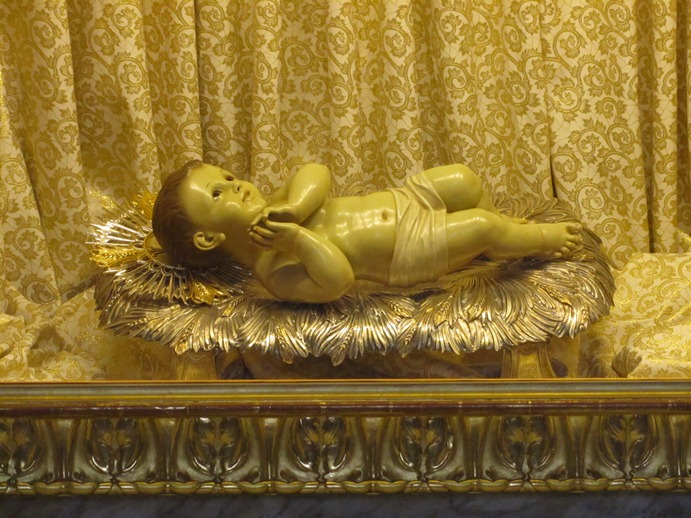
These past days I had the occasion to visit Bethlehem. I went there together with Fr Pacifico Sella OFM, who is a visiting lecturer in Medieval History here at the Franciscan Theological Institute. We visited the Basilica of the Nativity of the Lord, the Church of St Catherine, which is annexed to the Basilica and the Church of the Shepherds, located where the shepherds heard the good news of the birth of the Messiah, the Promised One. We visited also a small Church, a few meters away from the Basilica of the Nativity, called the Milk Grotto Chapel.
Baby Jesus carried on the night of Christmas
The Star of Bethlehem indicating where Jesus was born

It is a place where we are called to contemplate the truth of the Incarnation of the Word of God: “And the Word became flesh and dwelt among us, full of grace and truth” (Joh 1,14). “She gave birth to her firstborn, a son. She wrapped him in cloths and placed him in a manger” (Luke 2,7). This omnipotent God (“Even the nations are like a drop from a bucket, and are accounted as dust on the scales; see, he takes up the isles like fine dust” [Isa 40,15]), chose out of his infinite love for humanity (“for us men and for our salvation” – we say in the Creed) to become so little, so dependent upon one of his creatures. Yes, he needed to be fed; he needed to have his clothes changed; he needed to be cleaned.
The Door of Humility -- the Entrance to the Bethlehem Basilica
Our Lady feeding the Baby Jesus
The Milk Grotto in Bethlehem
Once again, we are called to reflect on how God chooses many times to manifest himself to us in weakness and simplicity. Pope Benedict XVI, in his homily during the Midnight Mass at Christmas 2011, reflecting on Isa 9,5-6, said: “We are presented with a vision that extends far beyond the historical moment into the mysterious, into the future. A child, in all its weakness, is Mighty God. A child, in all its neediness and dependence, is Eternal Father. And his peace ‘has no end’.”
The Church in the Shepherds' Field
Jewish Quarter
On Monday afternoon I visited, as part of the course by Prof. Alliata, the Jewish Quarter of the Old City of Jerusalem. This part of the city was completely restored after the six-day war of 1967. During this restoration they did also a lot of archaeological excavations which brought to light a number of interesting things, like, for example, two walls of which Josephus Flavius speak. These walls ran from the Citadel (Herod’s Tower), also known as the ‘Tower of David’, to the Antonia Fortress. All that was behind these walls, towards the South, towards the City of David, was within the city. All that was on the other side, towards the North, was outside of the City. The Golgotha and the Holy Sepulcher were in fact outside these walls. Originally, there was only this wall to defend the city from the North, as on the other sides there were valleys, thus needing no walls for defense.

Another interesting feature which came out as a result of the excavations made was the big Church built by the Emperor Justinian in honour of Mary, known as Santa Maria Nova. To make space for this Church the Emperor had to level some ground towards Mt Zion. The Church was some 100 meters long. Excavations have unearthed (although then they were covered again to make space for a parking lot!!) the façade and the apse of the Basilica.

Finally, in the Wohl Museum we saw also a number of important excavations which brought to light some houses which were close to the Temple Mount. There are a number of very interesting features, like mosaics, kitchen utensils, a number of baths both for hygienic purposes and for ritual purification purposes. These elements have induced archaeologists to think that those dwelling in these houses might have been priests serving at the Temple. One of the houses is very big and elaborate. Some are thinking that it might have belonged to the family of Caiaphas, the High Priest.

The Temple Mount
On Wednesday morning, I went to visit the Temple Mount, as the Jews call it, or the Noble Sanctuary, as the Muslims refer to it. This is the place, Mt Moriah, where the Jews believe that the foundation of the world lies. The Talmud states that it was here that God gathered the earth that was used to form Adam. Here Adam, Cain, Abel and Noah all performed ritual sacrifices. Here also Abraham was asked to sacrifice his son Isaac (Gen 22,1-19). Solomon built his first temple here and placed the Ark of the Covenant. After the destruction of this by the Babylonians and the return from exile, it is also here that the Second Temple was built in 515 BC. King Herod the Great upgraded the site by building a wall around the mount and filling it with rubble as to create an enormous plaza that we can see today.

Entrance to the Temple Mount is prohibited to Jews
After the destruction of the Temple in the year 70 AD, the Romans built a temple to Zeus, which was later to be converted into a Christian Church.
The Dome of the Rock

The Muslims consider this space as the third holiest place after Mecca and Medina. The Prophet Mohammed once announced that in a single night he had travelled to “the farthest mosque” and there led others in prayer. It was interpreted that this place was Jerusalem. In fact, “Al Aqsa”, the name of the Mosque on the Mount, means “farthest mosque”. Muslims believe also that it is from here that Mohammed ascended to heaven. This is the rock which is to be found under the Golden Dome. Unfortunately, only Muslims could enter both in the Al Aqsa Mosque and in the Dome of the Rock. However, the space is truly worth a visit. How many pilgrims, Jewish, Christian and Muslims have prayed here! How many people have pleaded to God in this place through at least three millennia of years!
Some men studying the Koran on the Temple Mount

The Gethsemane Trees

Finally, today we had the official opening of the Academic Year with an Academic Talk on the need for an integration of historico-critical method and theological exegesis by Prof. José Manuel Sánchez Caro. The results of three years of scientific studies of the eight olive trees in the Gethsemane were also presented to us. The results show that these trees are healthy and they are coming from one origin; they are “brothers”. They were dated to the Twelfth Century AD. Some dates were given: tree one: 1198; tree 4: 1092; tree 7: 1166. The experts say that this makes these trees some of the most ancient olive trees in the world! Whoever planted these trees wanted to make the memory of the Gethsemane Garden and all it witnessed on the night when Jesus was in agony and was betrayed. The need for the collaboration between faith and science was emphasized.
The Conference on the Gethsemane Trees